Everything is a Season: Year of the Shining Horse
This week, solar and lunar calendars conspired to give us an interesting set of concurrent celebrations. Among them were Mardi Gras — or Carnival — and the Lunar New Year — Year of the Shining Horse — on February 17. The coincidence sharpened my sense of time and how we measure it, season by season as well as place to place.
It also kindled a memory from the past year, a past season — a revelation in its own way. I attended Osaka Expo 2025, and the China Pavilion was its star. The last thing I thought I’d learn from it was the 24 solar terms of ancient agrarian China.
I visited China in 2012. I saw the Bird’s Nest in the Olympic Park. I sweated my way through endless courtyards of the Forbidden City. I studied the faces of the warriors in Xi’an. I biked along the Li River, marveling at the karst landscape. I never once gave a thought to the 24 solar terms or seasons. It was only in Osaka where I became aware of the Chinese solar cycle. It framed the seasons within days instead of months and, in doing so, honored nature and those who toil in it.
The 24 Solar Terms Disc sits at the heart of the pavilion. The nearly 100-square-meter oculus is an LED moon removed from its orbit. It was designed by art master Chang Shana at age 91 and animated by China Film Group. Together, they created a time machine, not one that takes you to a new time but one that slows time down. The great disk wheels through the seasons. But it is not the familiar four-part sequence of winter, spring, summer, autumn. Instead, there are seasons within seasons — two dozen. They came alive through vivid, simple terms and beautiful illustrations.

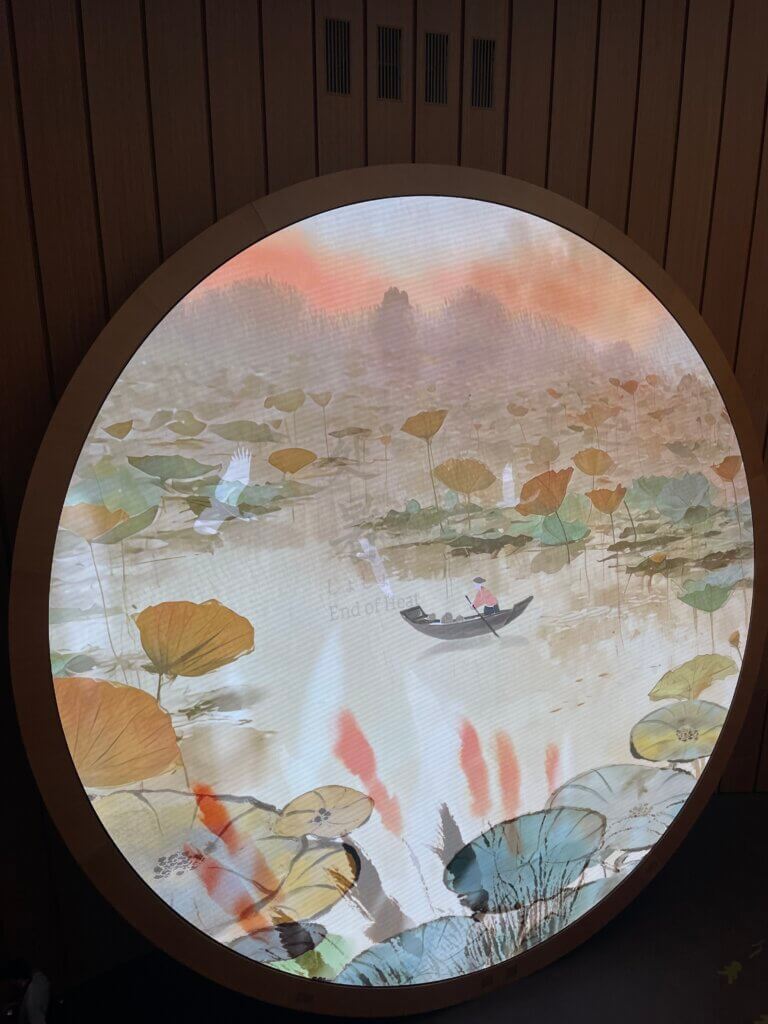
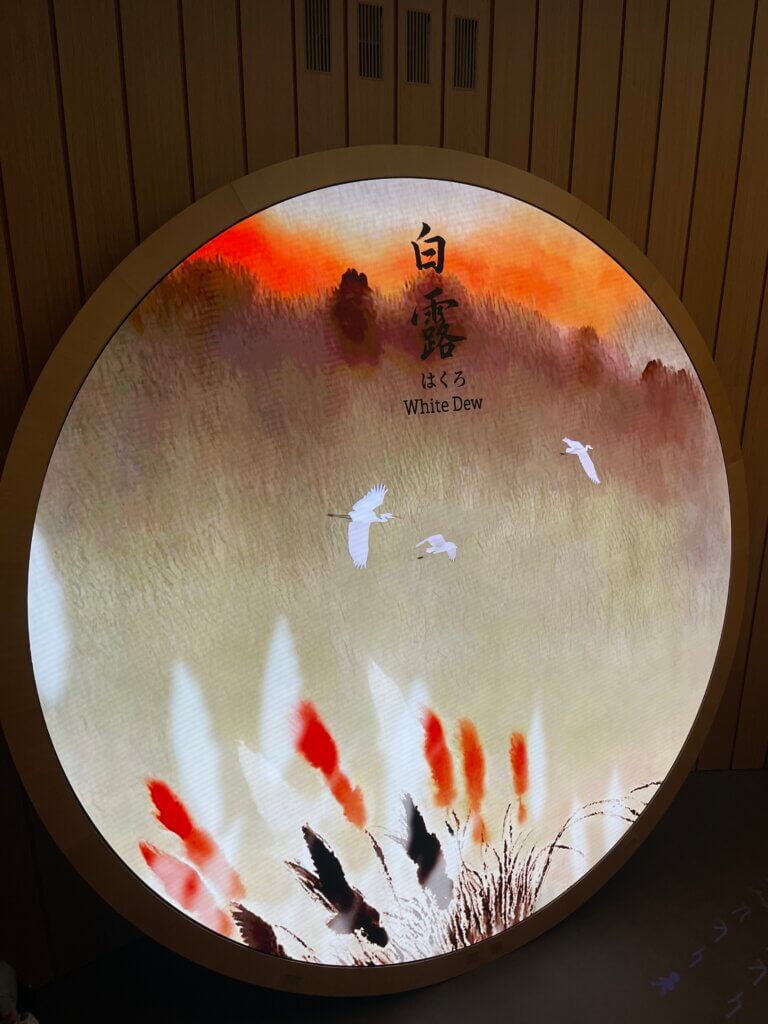
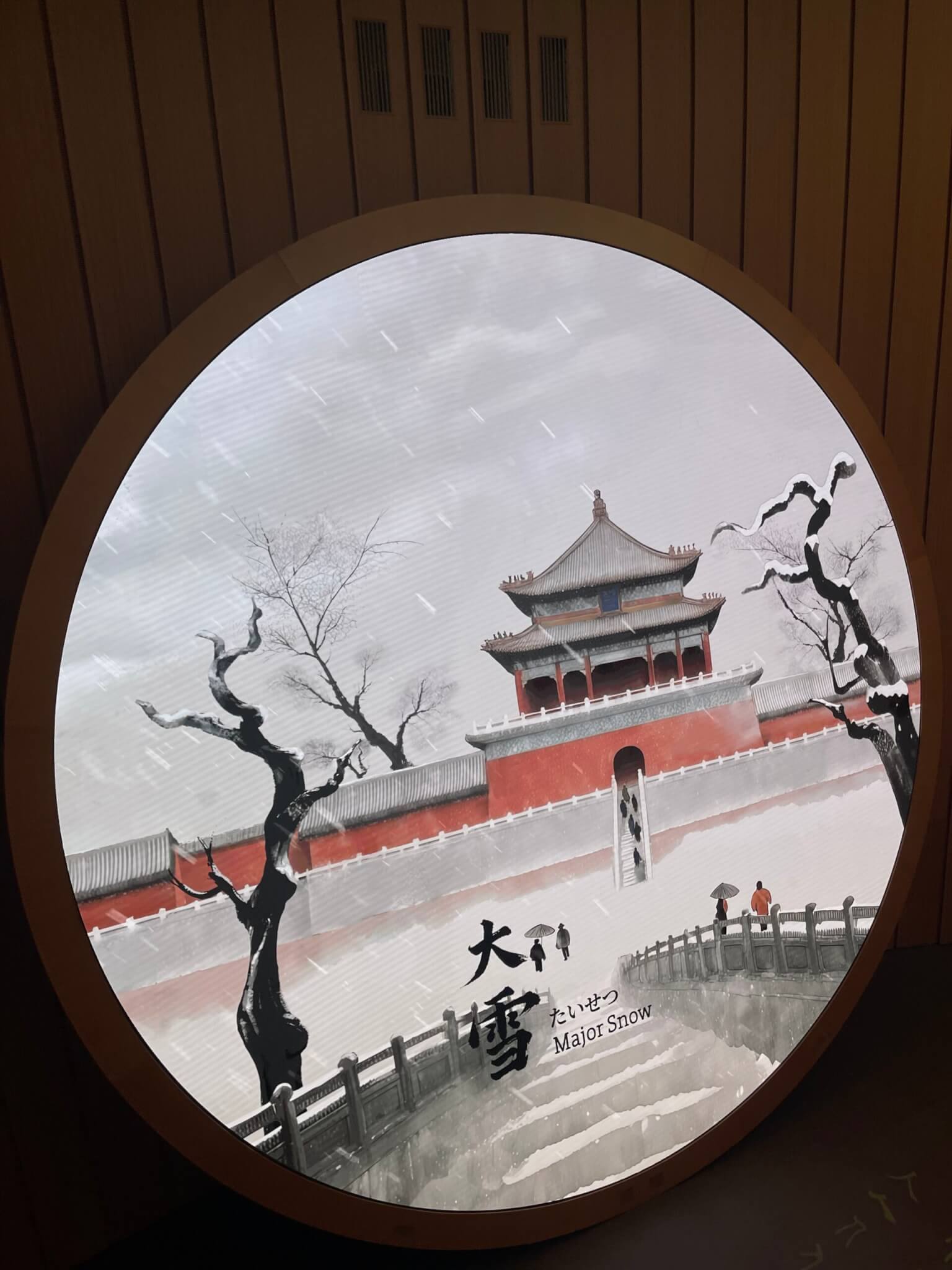
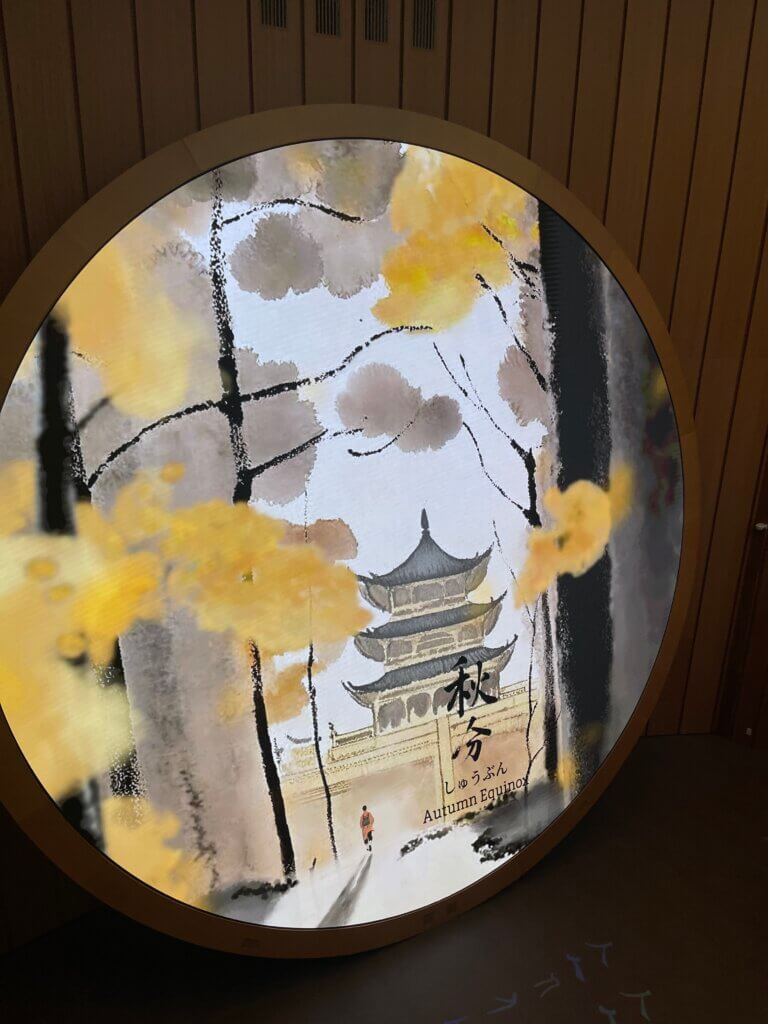


I was mesmerized by the artwork, the technology, the scale, and the poetry of this ancient way of describing the cycles of the natural world. I could almost feel the heat, rain, frost, and dew on my skin as one bucolic scene, one poetic label, dissolved into another.
Ecological in practice, poetic in description, authentic in origin, these 24 solar terms underpinned traditional Chinese agriculture for 5,000 years. As the giant LED oculus cycled through the year, I could almost feel the frost arriving in stages, heat cresting and ebbing, rain falling in specific measures and moods.
Describing a year’s seasonal complexity in just four words is like limiting color to red, white, blue, and black. I promised myself not to forget this insight.
I can’t say that I’ve done a great job honoring that promise, looking for Slight Heat and Great Heat, White Dew and Cold Dew, Slight Cold and Great Cold, the Awakening of Insects, or Pure Brightness. But this ancient Chinese wisdom and the modern presentation of it at the China Pavilion have made me more attentive to the slow and small arcs of change traced by sun, wind, rain, plants, and bugs.
The 24 terms might have come across as quaint — “Grain Rain,” “Lesser Fullness of Grain,” “Grain in Ear” — had the beautiful animation not set a pace and mood of contemplation suitable for a knowledge system and social practice.
Cultural messaging is everywhere inside and outside the China Pavilion. The wooden façade announces that you are about to take in both old and new: ancient wisdom delivered in LED. The building reads first as text and only second as a work of architecture — a forest of vertical bamboo “slips,” text messaging at scale, fanned out to invoke an unfurling scroll.
The pavilion is the future of museums. The glass walls of vitrines and other surfaces wake under your touch. Text pops up, offering context for the exhibited objects, everything from soil samples to satellites. Then it fades back to transparent glass. Visible/invisible object rhymes with visible/invisible text. Information appears at your bidding and then steps aside when it has done its work. More than any single gadget, this is what made the space feel like the future of museums — interpretation fully integrated into the architecture and no longer bolted on to the side.
At Dubai Expo 2020, China’s pavilion leaned hard into the language of trade, logistics, and opportunity. Commerce rather than culture dominated. It was like a high-gloss chamber-of-commerce brochure in 3D. It was also a bore.
In Osaka, it was completely different. Economic power was still implied, but screened through ecology, culture, and a long historical memory. Instead of asking you to consider supply chains, this pavilion asked you to inhabit the cycles of a civilization’s seasons, from bamboo slips to lunar exploration.
The shift reads, above all, as a new level of cultural confidence. The story on offer is unapologetically civilizational, but rarely lapses into chest-thumping. It suggests that technological achievement is simply one more branch on an older tree whose roots, we are asked to believe, are environmental and aesthetic.
I left the China Pavilion with the 24 seasons cycling in my mind, each frame dissolving into the next: the waking of insects, the ripening of grain, the lesser cold that arrives before the greater cold. To name 24 seasons instead of four is to commit to noticing the seams where one pattern gives way to another. The Year of the Shining Horse will gallop along but I hope I stop to notice when Grain Rain falls and White Dew greets the morning sun.
Leave a Reply